Showing posts with label Edmunds. Show all posts

Wednesday, July 27, 2011

Edmunds.com Announces True Cost to Own(R) Award Winners: Honda and Ford Vehicles Shine

SANTA MONICA, Calif., Jul 25, 2011 (BUSINESS WIRE) -- Honda Motor Co. won five categories in the 2011 Lowest True Cost to Own(R) Awards, given by Edmunds.com, the premier online resource for automotive information. The awards name the 2011 model year cars and trucks in 23 categories that offer the lowest True Cost to Own(R) (TCO(R)), which is the projected ownership cost over a five-year period.

The 2011 Honda Accord earned victories in two categories: Coupes $25-$35K and Sedans $20K-$30K. Honda's other award winners are the Honda Civic Hybrid (Hybrids), the Honda Ridgeline (Large Light Duty Truck) and the Honda Pilot (SUV $35K-$45K).

Ford Motor Co. also had a strong showing in this year's awards, with Edmunds.com recognizing the Ford Ranger (Compact Truck), the Ford Flex (Wagon Over $35K), the Ford Fiesta (Sedan Under $20K) and the Ford Transit Connect (Van/Minivan).

The other automotive brands receiving at least two awards were Chevrolet and Cadillac.
"One of the key factors that pushed many of this year's award winners over the top was their free maintenance plans, which can save car owners hundreds or even thousands of dollars over a five-year period," said Danny Zhou, senior director of data products and operations at Edmunds.com. "The 2011 Volkswagen CC, for example, edged past its closest competitors in the Sedan $30K-$40K category in large part because it offers free maintenance for three years or 36,000 miles."

To calculate the Lowest True Cost to Own(R) winners, Edmunds.com uses an algorithm that takes into account depreciation, interest on financing, taxes and fees, insurance premiums, fuel, maintenance, repairs and any federal tax credit that may be available. In order to estimate certain mileage-dependent costs, Edmunds.com assumes that vehicles will be driven 15,000 miles per year. Only vehicles launched during the period from July 29, 2010 to April 14, 2011 were considered for the 2011 awards.

To see the full list of all 23 winners this year, please visit the award page at http://www.edmunds.com/car-reviews/2011-lowest-cost-to-own.html .

Consumers can learn more about Edmunds.com's True Cost to Own(R) (TCO(R)) before they buy their next car at http://www.edmunds.com/tco.html .

About Edmunds.com, Inc. ( http://www.edmunds.com/help/about/index.html )
Edmunds.com Inc. publishes Web sites that empower, engage and educate automotive consumers, enthusiasts and insiders. Edmunds.com, the premier online resource for automotive information, launched in 1995 as the first automotive information Web site. Its mobile site, accessible from any smartphone at www.edmunds.com , makes car pricing and other research tools available for car shoppers at dealerships and otherwise on the go. InsideLine.com is the most-read automotive enthusiast Web site. Its mobile site, accessible from any smartphone at www.insideline.com , features the wireless Web's highest quality car photos and videos. AutoObserver.com provides insightful automotive industry commentary and analysis. Edmunds.com Inc. is headquartered in Santa Monica, California, and maintains a satellite office in suburban Detroit. Follow Edmunds.com on Twitter@edmunds and fan Edmunds.com on Facebook at http://www.facebook.com/edmunds .

Source;
http://www.marketwatch.com/story/edmundscom-announces-true-cost-to-ownr-award-winners-honda-and-ford-vehicles-shine-2011-07-25?reflink=MW_news_stmp

Saturday, November 8, 2008

Edmunds Comparison Test: 2009 Honda Civic Hybrid vs. 2009 Honda Fit Sport

Family Feud
By Josh Jacquot, Senior Road Test Editor Email Blog Date posted: 11-04-2008

They're not fast, they don't corner hard and they're certainly not the most pulse-quickening cars we've ever tested at Inside Line. But if fuel-efficiency and utility are priority items in your next car purchase, then the 2009 Honda Civic Hybrid and 2009 Honda Fit Sport are unbelievable machines.

Combining economic operation and utility like few other cars sold today, either of these Hondas is a responsible choice for the buyer looking to save fuel, minimize emissions and haul the family. Each has its own unique qualities — important distinctions that can't be overlooked.

The question, then, is which is the better car? To figure it out, for two weeks we used the 2009 Honda Civic Hybrid and the 2009 Honda Fit as they're designed to be used. We drove them to work, loaded our families in them, packed our groceries in them and took them to the track to measure their performance. We argued the merits of the Civic's superb fuel economy vs. the Fit's exceptional utility.

In doing so, we designed this test to suit the priorities of a buyer looking for reasonably priced utilitarian transportation. Accordingly, fuel economy and price make up the majority of each car's total score at 25 percent each. Performance, feature content and our 29-point evaluation score make up 15 percent each, while editors' personal and recommended picks combine for the remaining 5 percent.

The Distinctions
Both our test cars represent the very top of their respective model lines. In other words, you can't buy a more expensive Fit or Civic.

Our 2009 Honda Fit Sport test car included the new-for-2009 five-speed automatic transmission, which complements the Fit's 1.5-liter inline-4 engine rated at 117 horsepower and 106 pound-feet of torque. Including Honda's voice-recognition navigation system brings the Fit Sport's cost to $19,430 including destination.

The hybrid powertrain isn't the only feature jacking up the Civic's price. This car also has been equipped with a navigation system and leather seats, which pushed its sticker (including destination) to $27,420 — nearly an $8,000 premium beyond the Fit Sport. The combined power rating of its 1.3-liter, inline-4 gasoline engine and 20-kilowatt electric motor is 110 hp and 123 lb-ft of torque. A continuously variable transmission puts power to the ground.

If it's air emissions you're concerned with, the Civic is EPA-certified as a Tier 2, Bin 2 polluter, while the Fit earns a Tier 2, Bin 5 rating. The California Air Resources Board (CARB) classifies the Civic as an AT-PZEV and the Fit as a ULEV2. In case you're not familiar with the alphabet soup of emissions ratings, this means that the Civic emits roughly as many pollutants while running for a week as a 1976 Chevy Beauville Van does leaking oil in your driveway for a day. And the Fit emits only a little more.

Both cars are fitted with front, side and curtain airbags; stability control; and antilock brakes.

Living With Them
Unlike the Toyota Prius, the 2009 Honda Civic Hybrid manages to look and act like a normal car. There's a conventional key to start the engine, and a conventional shifter. Short of its goofy wheels, there's very little giveaway visually that this is a hybrid. Start driving, however, and it's clear this is no normal car. Its electric-assisted power steering lacks the feel and response of a conventional Civic and it quickly becomes obvious that handling hasn't been a priority in the tuning of its chassis. If, like most hybrid owners, you're not one to be engaged by the way a car feels when you drive it, then there's little here to dislike.

Here's something funny. Jump out of a Civic Hybrid and into a Fit and you'll swear you're driving a sports car — even with the automatic tranny. The Fit's shift paddles on the steering wheel allow you to downshift for a corner and exercise precise control over engine braking — the Civic can't manage either of these tasks. There's better steering feel, a more responsive powertrain and relatively engaging handling in the Fit as well. Bottom line: It's a hell of a lot more fun.

But your extra money does get you more than a hybrid powertrain in the Civic. Its leather-upholstered seats and automatic climate control are worthwhile amenities that aren't available in the Fit. Plus, it's a just a nicer car, without the noticeable evidence of cost-cutting that's easy to find in the Fit.

Reality
The truth is, if you're willing to overlook the Civic's awkward control feel and miserably slow acceleration, both of these cars will serve you well for daily commuting and family hauling, which is really what they're for.

But you don't have to look far to realize how much more practical the 2009 Honda Fit is when it comes to moving cargo. Even with its rear seats in the upright position, it offers almost twice as much cargo space as the Civic (20.6 cubic feet vs. 10.4 cubic feet). Fold those seats flat and cargo volume expands to a massive 57.3 cubic feet. Plus, the Civic simply can't compete with the Fit's flexibility when it comes to configuring the cargo area.

With the ability to raise its split-folding seat bottoms against their seatbacks, the Fit is unmatched in this aspect of utility. The Civic, meanwhile, lacks even a simple pass-through into the trunk because its battery pack is in the way.

Fuel Consumption
We measured fuel economy using two sets of criteria. First, we performed a test in which both cars were driven twice in controlled conditions — one highway route totaling 83 miles and two city loops totaling 180 miles. Driving the cars together and using the same driving style and similar speeds ensured equal conditions for both cars. Air-conditioning was used during city testing and one driver refueled both cars at the same pump using the same fill technique.

We use the EPA's combined fuel economy number for fuel economy scoring in this test, but offer our own test results to demonstrate how each car performed in various conditions with our editors behind the wheel.

For the rest of the article (it's a good read);
http://www.edmunds.com/insideline/do/Drives/Comparos/articleId=135206#1

Wednesday, September 24, 2008

Edmunds Inside Line: 2009 Honda FIT Full Review

Now Fit for America
By Chris Walton, Chief Road Test EditorDate posted: 2008-09-22 21:00:00.0

"It reminds me of last year's Fit without being last year's Fit." That's how Photo Editor Kurt Niebuhr described the 2009 Honda Fit Sport with Navigation. And he should know, since he logged thousands of miles in our 2007 Honda Fit Sport long-term test car in the course of various photo assignments.

And once you count the number of changes made to the 2008 Honda Fit, you discover that the 2009 Fit is as all-new as a car can be without being labeled all-new. The improvements include new sheet metal, new chassis structure, new interior, new engine block, new valvetrain, new electronics, new features and new options.

Unlike some product updates, the Fit version 2.0 manages to retain all the things we loved about the space- and fuel-efficient little wedge, while deleting those flaws that frustrated us.

A Worm Hole Comes Standard
The Honda Fit has always seemed like a car that is outside the boundaries of Euclidean geometry because it feels much larger on the inside than its exterior dimensions suggest. Now the all-new interior of the 2009 Honda Fit manages to carve out even a little more room for both passengers and stuff while growing almost imperceptibly on the outside.

Ever more slender roof pillars, wheels even farther toward the corners of the car, and a windshield pushed farther forward have all netted both real and perceived gains in interior roominess. The tape measure says the occupants of the rear seat enjoy the benefits of this growth spurt most, as even an inch or two back there makes a noticeable difference.

Another benefit of this larger footprint is that the second-row seatback now has enough room to flop forward to make a flat cargo floor without having to slide either of the first-row seats — a measure introduced last year as a result of customer complaints about the 2007 Fit. But don't fret, as the seat bottoms still flip up to accommodate items as tall as 50 inches through the rear doors. Meanwhile, the liftover height of the rear hatch has been lowered to an easy-on-the-back 24 inches.

The reshaped front seats are more comfortable, but what's even better is the improvement in the overall driving position, especially for tall people. First, the steering wheel now tilts and telescopes. The throttle pedal has been angled to move fore and aft instead of up and down, a far more natural movement when you're sitting farther back from the steering wheel. The footwell is larger and there's a dead pedal to rest your left foot on while cruising. All that's really needed now is a height-adjustable driver seat.

It's How You Use It
The specifications tell you the 2009 Honda Fit's 1.5-liter inline-4 engine makes only 1 more pound-foot of torque at its maximum of 106 lb-ft at 4,800 rpm, but it's everywhere else in the rev range where the Fit's engine feels more responsive.

Where the previous version of the engine felt lethargic and in need of revs to motivate this 2,500-pound car, the new Fit inline-4 gets with the program from as low as 2,000 rpm. It's easier to drive more of the time, so you no longer feel the need to rev the Swiss out of it.

The low-effort action of the cable-type shift linkage of the five-speed manual transmission remains a model of excellence, offering the same precisely located gates and generally cooperative mechanicals. Neither the shifter nor the clutch pedal feels fragile or limp, even when hurried.

Small Car, Big Ride
The 1.0 version of the Fit would dance and wiggle over anything but the smoothest roads. The new car gains a measure of stability from a wheelbase that's 1.9 inches longer and a track that's 1.4 inches wider in front and 1 inch wider in the rear. In addition, the suspension geometry has been changed to offer more stability while the components have been tuned for a more comfortable ride. This also results in improved composure around sweeping turns, so we don't feel as if constant vigilance is required anymore.

The revised electric-assist power steering still feels light in effort by any standard, but now it reminds us of a Civic Si instead of a CR-V, and that's a good thing. Maybe the adaptation of the Civic Si's steering wheel to the new 2009 Fit helps, too.

The brakes are now easier to modulate and offer a more intuitive pedal feel, even if our car's stopping distances were longer than the last Fit Sport we tested. Thank the new brake master cylinder and the standard electronic brakeforce distribution for the added feel.

Taken as a whole, the engine, steering, braking and ride characteristics of the 2009 Fit have all been calmed down, so there's no implied, expected or perceived dynamic compromise in driving a small car. Even a novice driver would choose the 2009 Honda Fit over the car it replaces simply for the effortless way it drives.

Anomaly or Fuel Economy Trade-off?
Some laws of physics can't be ignored, so while the 2009 Honda Fit is more powerful, it's also a little slower and fractionally less efficient. Fuel economy has dropped 1 mpg in both the city and highway EPA estimates. Our mixed driving average produced 30 mpg, which is 1 mpg better than the EPA's estimate of the car's combined average.

Though the 1.5-liter engine's output has risen to 117 horsepower at 6,600 rpm (an improvement from 109 hp at 5,800 rpm), our acceleration testing didn't prove the 2009 Fit Sport as quick as its predecessors. It runs to 60 mph in 10.2 seconds (9.8 seconds with 1 foot of rollout like on a drag strip) and covers the quarter-mile in 17.3 seconds at 79 mph. This performance compares with our 2007 Fit Sport, which reached 60 mph in 9.4 seconds and completed the quarter-mile in 16.8 seconds at 79.8 mph. Although there have been changes to the ratios of the five-speed manual transmission to accommodate the new, taller 16-inch tires of the 2009 Fit Sport, the overall gearing remains effectively unchanged, so we're not sure what the explanation for this performance might be.

Meanwhile, the new 185/55R16 Bridgestone Turanza EL470 tires are narrower than the Sport's former 195/55R15 Dunlop SP37s, so there's a little less grip. Our best stop of 134 feet is longer than average for such a small, light car, and we suspect the 10 feet of additional stopping distance compared to our 2007 Fit is largely due to the tire swap.

Around the skid pad, the '09 Fit Sport managed to hang on to the asphalt with 0.78g of grip and ran between the slalom cones at an average speed of 64.1 mph, which compares to the previous car's 0.79g and 66.3-mph performances.

Upgrading the Experience
Navigation systems are becoming nearly expected these days, so naturally the Fit incorporates one that's operated through a 6.5-inch touchscreen with voice activation. And since electronic stability systems will soon be mandated on all passenger cars, the 2009 Honda Fit Sport has one (although the base model does not).

There's a new USB connector for audio devices in addition to the aux jack that was already in place. Illuminated steering-wheel audio controls are now included in the Fit Sport and, are you ready for this? Driver and passenger vanity mirrors plus map lights are standard on the Fit Sport! Honda often pinches pennies on details like this, so their inclusion is more significant than you might think.

It's the Right Time To Be Fit
When the Fit first arrived here in late 2006 as an '07 model, gas prices were about $2.30 per gallon and there didn't seem to be much of a compelling proposition for such a Japan-centric small car as the Fit. But now that gasoline peaked above $4 per gallon this summer, Honda ran out of its allotment of 85,000 Fits by September. Honda took a chance with its little car, and it paid off big.

The 2009 Honda Fit now fits our recently tightened American budgets, our ever varying cargo and passenger needs, and finally our 95th-percentile biometric bodies. This car is plainly not built to win races; instead, it's built to squeeze as much efficiency as possible out of every gallon of gas and every cubic foot of interior volume.

For the money, the 2009 Honda Fit Sport is the best small car for sale in the U.S. for most people.

Source;
http://www.edmunds.com/insideline/do/Drives/FullTests/articleId=132028?tid=edmunds.il.home.photopanel..3.*

Tuesday, September 9, 2008

Japanese Honda Odyssey Spotted Tested in CA

The above cell phone image of a JDM Honda Odyssey was spotted in Palos Verdes, CA recently. The car was wearing "3421" manufacturer license plates, which apparently Honda uses.
This is a older post from Edmunds.

Well this is a interesting development, I have been under the full impression that it would be the Honda Stream that would make its way to the North American market. Now, that's not to say that Honda is testing this vehicle for this market, they could be doing weather condition tests. Only time will tell.

Source;
http://blogs.edmunds.com/straightline/2008/07/jdm-honda-odyssey-spotted-in-ca.html

Edmunds Review: 2008 Honda Civic Mugen RR

Honda's Own Skyline GT-R
By John Barker, Contributor Email Date posted: 09-08-2008

Our first sight of the rarest and probably most desirable Honda Civic on the planet is a flash of blood-red paint and a glint of black wheel spokes a couple of hundred yards away, parked in a roadside turn-off in the middle of England. Even at this range, we know it's the real thing, and up close the 2008 Honda Civic Mugen RR is even more striking.

When the Mugen RR went on sale in Japan last September, all 300 examples were snapped up in just 10 minutes. This is the only example in the U.K. and is likely to remain so, as RRs are now changing hands at a premium in Japan. While the standard Honda Civic Type R costs $25,600 in Japan, the Mugen RR went for $43,900.

That's a premium of $18,300 for what appears at first glance to be a gentle massaging of the already impressive JDM Civic Type R sedan. The more you delve into the details of the 2008 Honda Civic Mugen RR, however, the more plausible becomes Mugen's claim to have built the ultimate front-drive car.

The Mugen Way
Mugen, of course, is the Japanese word for "Unlimited," and it began when Hirotoshi Honda built a racing car in his father's workshop back in 1965 while he was still a student at Nihon University. And, yes, his father was Soichiro Honda, the patriarch of Honda. Mugen has specialized in high-performance and motorsports with Honda products since it was formally established, although the company was restructured in late 2003 under the ownership of M-TEC.

Mugen is well known for offering tuning and styling parts for Hondas, but everything on the RR is unique and will not be on sale separately. Take a chunk out of one of the forged-aluminum 18-inch wheels and you'll have to prove that you own an RR to get another. The same goes for the carbon-fiber front airdam and rear aero diffuser, the aluminum vented hood and the adjustable carbon-fiber rear wing.

Despite these lightweight pieces, the RR is only 22 pounds lighter than the Honda Civic Type R upon which it is based, even with the lightweight carbon-fiber Recaro racing seats inside the cabin.

You won't find a substantial power uplift either. In prototype form, the RR was said to have a 256-horsepower, 2.2-liter version of the Honda K20A engine, but the production version sticks with the standard displacement of 1,998cc. Mind you, the 237 hp it does produce is more power than the stock 222-hp Type R unit. The improvements come from a ram-air intake, a larger cold air box, new intake and exhaust camshafts, stiffer valve springs, a 4-2-1 exhaust manifold, a low-restriction catalyst and dual exhaust.

Track Record
Now, we're big fans of the Honda Civic Type R, even though its appearance in Japan as a four-door sedan instead of a three-door coupe caused something of a scandal (Honda U.K. even built its own Type R coupe in response).

The Type R's grooved, street-legal slicks, limited-slip differential and a K20A with a 9,000-rpm redline make it pretty impressive. The Mugen RR sets out to be even more focused, but we can't help but cynically imagine that this will be like the difference between a four-blade and a five-blade disposable razor, i.e. largely imaginary. After all, the Civic Type R's own K20A spins out 225 hp at 8,000 rpm and 158 pound-feet of torque at 6,100 rpm.

Nevertheless, the Mugen RR is 2 seconds quicker than the Type R around the Tsukuba Circuit, the 1.3-mile road course that Japanese car manufacturers regard as an important standard of speed just like the Nürburgring Nordschleife (only, you know, shorter). So the RR does the business.

For the rest of the article;
http://www.edmunds.com/insideline/do/Drives/FirstDrives/articleId=131768?tid=edmunds.il.home.photopanel..1.*#2

Monday, September 8, 2008

Edmunds Comparison Test; Honda Accord VS New Mazda 6 VS Nissan Altima

Comparison Test: 2009 Mazda 6 vs. 2008 Honda Accord vs. 2008 Nissan Altima
1st Place: 2009 Mazda 6 - For 2009 Mazda takes the styling up a notch, dials out some harshness and dethrones the benchmark Honda Accord.
2nd Place: 2008 Honda Accord - Providing exactly what's expected but nothing more, the Accord will still supply miles of performance.
3rd Place: 2008 Nissan Altima - Widely considered the sportiest front-drive family sedan, the slick Altima comes up short this time around.

Finding the Sweet Spot in Family Sedans
By Chris Walton, Chief Road Test EditorDate posted: 09-07-2008

Our recent test of the 2009 Mazda 6 s Grand Touring showed us that Mazda can still offer sporting dynamics in its all-new family sedan, even while providing more room, more features and more power. We were concerned that the sporting spirit of the last-generation, fun-but-snug Mazda 6 might have been lost in the search for commercial success, but we came away believing this new car still has that zoom-zoom thing.

Like Mazda, we believe a family sedan can be lively as well as practical. So to gauge the way in which the 2009 Mazda 6 fits into the new world of family sedans, we figured a comparison is in order. A 2009 Mazda 6 s Grand Touring would be our starting point.

Then we enlisted the 2008 Nissan Altima 3.5 SE with its continuously variable automatic transmission. It's the car that most people consider to be the sportiest in this category, matched with a transmission that shatters all expectations about CVTs. (We know this car is available with a manual transmission, but we also know the CVT is a better choice. Trust us.)

The all-new 2008 Honda Accord is the standard of the category, the winner of our last comparison test of family sedans. A 2008 Honda Accord EX-L Navi matched up nicely. Hailed for its value, refinement and excellent quality, the well-mannered Accord would challenge the Mazda's practical abilities.

And so we began our family sedan comparison test, and we're wondering how far the Mazda 6's fun-o-meter has swung away from "I could use a Red Bull" toward "My adrenal gland is sore and I need to grow up."

For the rest of the article;
http://www.edmunds.com/insideline/do/Drives/Comparos/articleId=131667?tid=edmunds.il.home.photopanel..1.*#2

Wednesday, August 27, 2008

Edmunds Blog; Honda Awaiting New "Super" Lithium-Ion Battery for Next-Generation Hybrids

Honda's Integrated Motor Assist mild hybrid system (right) would get a boost from new high-power lithium-ion batteries the company could start using for 2010 models.

By Bill Visnic, Senior Editor

TRAVERSE CITY, Mich. -- Honda Motor Co. is preparing for an all-new, advanced lithium-ion battery that will allow its engineers to extend Honda's Integrated Motor Assist hybrid-electric technology to larger vehicles, a senior company executive told Green Car Advisor during an annual auto-industry conference frequented by heavy-hitters from carmakers' management ranks.

Honda has in the past been non-committal about lithium-ion, but that posture apparently is changing. And Honda recently was linked in lithium-ion talk with Japanese electronics giant and battery developer Sanyo Electric Co.

John German, American Honda's manager of environmental and energy analysis, said the coming lithium-ion battery formula -- the developer of which he wouldn't name -- does not enjoy extra capacity compared with known lithium-ion characteristics. Instead, the new chemistry is targeted at allowing the batteries to charge much more quickly.

This, in turn, will allow for an increased amount of battery capacity that can be assigned to actually powering the motor. And more power means the IMA system can be employed for larger, heavier vehicles.

In addition, German says the new batteries will be markedly cheaper.

Apart from potential for vehicles such as the Ridgeline midsized pickup or the Odyssey minivan, the extra IMA performance could mean a return of the Accord Hybrid - this time using a 4-cylinder engine instead of the first-generation Accord Hybrid's V6.

German says the new butt-kicker lithium-ion chemistry should be ready in about the same timeframe as GM's lithium-ion-dependent Chevrolet Volt "extended-range" electric vehicle, the car that put lithium-ion development on the hot seat.

And while Honda brags about the slenderness of IMA's engine-enhancing electric motor - which is wedged between the engine and transmission - German says underhood space has become so valuable that even the currently required 1.5 inches or so is tough to engineer.

But Honda's advanced lithium-ion battery's potential for the midsize Accord must be tempting, as the company is no doubt anxious to get back in the game against Toyota's Camry Hybrid, of which Toyota reputedly has just a five-day inventory.

Honda's first Accord Hybrid was designed for performance enhancement, coupling the IMA system with the company's thrusty 3-liter V6.

Accord's loyal buyers didn't respond, however, and Honda dropped the Accord Hybrid after the '07 model year and before the next-generation model was introduced for '08.

While Toyota's hybrids keep selling well, German told Green Car Advisor, that he thinks Toyota invested in the wrong technology by opting for the "full" hybrid design instead of Honda's IMA mild hybrid system.

"We get 80 percent of the (full-hybrid) benefit at 60 percent of the cost," German insists.

Source;
http://blogs.edmunds.com/greencaradvisor/2008/08/honda-awaiting-new-super-lithium-ion-battery-for-next-generation-hybrids.html

Saturday, June 21, 2008

Nice Article About When Times are Tough, Why People Flock to Honda

Here's a nice observation by the people at Edmunds.com about Honda's recent success' in the face of a down market.

Suddenly Honda is a success — again. The 2008 Honda Civic became America's current best-selling vehicle in May, as some 53,299 examples hit the road in a single month. This is a new sales record for the Civic, almost 14,000 more cars per month than the previous record for the model that had been set just the year before.

When times are tough and gasoline prices rise, people come home to Honda. There's something unique about this company that seems to speak to Americans. As Toyota rose to its preeminent position in the last few years, there were those who despaired of Honda's future, as it seems so one-dimensional compared to diversified mega-corporations like Toyota. After all, Honda is just a simple little car company.

Yet now this simple little car company is promising the introduction of a new 50-mpg hybrid vehicle in 2009, one of four compact Honda hybrids that are expected to represent 500,000 sales a year by 2015. At the same time, it's developing a new front engine NSX powered by a 550-horsepower V10 and featuring all-wheel drive. And Honda is equally capable of unexpected innovation, as with its unibody Ridgeline pickup truck, which more manufacturers are adopting as the template for fuel-efficient trucks in the future.

When the subject is sales, people talk about Toyota. But when the subject is cars, people talk about Honda.

Here's the rest of the article;
http://www.edmunds.com/insideline/do/Features/articleId=127406?tid=edmunds.il.home.photopanel..3.*

Monday, January 28, 2008

Honda Civic Si -VS- VW Golf GTI

Here's a nice comparison between to rival cars by Josh Jacquot, Senior Road Test Editor at Edmund's Online. I know it is a couple of years old, but the two cars are virtually the same today, so I didn't think it would matter.

Here are most of the highlights;

Honda's Civic Si comes with an i-VTEC-motivated 2.0-liter four-cylinder pumping out 197 hp at 7,800 rpm. Honda relies on engine speed instead of boost for motivation, so torque is only 139 lb-ft. Like the GTI, the Civic comes with a six-speed manual transmission as standard equipment, but unlike the GTI, it uses a helical limited-slip differential to put power to the ground.

This contest was close almost everywhere. Both cars have similar power, offer similar features and have similar build quality inside and out. Plus, their performance numbers were a wash. Quarter-mile and 0-60 times were only one-tenth of a second apart.

But there were two critical areas that made a difference in this battle: weight and cost. The GTI has more of both and together they were enough to tip the scale in the Si's favor. Yanking around about 400 pounds of extra ballast hurt the GTI's connection to the road, and the additional $3,335 it takes out of your wallet won't do your children's college fund any favors.

These two factors combined to turn our scoring system against the German hatchback. However, the reality is that it's an exceptional car — and probably more versatile than the Si given its shape and configurable cargo area. Its engine is also far more flexible than the Honda's and its chassis is a huge improvement over previous GTIs.

The Civic, too, is a nice machine. Despite design features we can't stand, like the two-tiered instrument cluster and A-pillars that rival the span of Golden Gate Bridge, there's no denying that it's sharper than the GTI when it comes to hard driving. And it's a heck of a lot less expensive.

In a class where most buyers will use these vehicles as their only car, practicality and performance both count. Costing 15 percent less, possessing better handling and being just as quick or quicker make for a strong argument in the Honda's favor, giving the Civic the win.

Both really nice cars; here is the whole article;

Tuesday, January 8, 2008

Edmunds 4 Cylinder Comparison Test; Accord VS Camry VS Malibu

It's nice to see a 4 cylinder comparison between these cars, b/c I find most reviews are on the V6, but most people end up with the 4 cylinder. The 4 cylinder engine in the Accord from what I have found drives more like a small V6 anyway. (I used to drive a 1995 Pontiac Grand Am GT 3.1 litre V6 and I think the 4 cylinder in the Accord would put the 3.1 litre to bed.) I imagine the 4 cylinder in the new Malibu would be pretty energetic too (haven't driven one yet), and I know the Camry has a nice 4 cylinder as well. Anyway, onward to the write up highlights;

3rd Place: 2007 Toyota Camry LE Sedan AT
A front-wheel-drive midsize sedan with a four-cylinder engine is an inherently sensible form of transportation. But the Toyota Camry LE takes it to an extreme, asking its driver to forgo all involvement in the motoring experience in trade for a soft, isolated ride, carefully insulated from the travails of everyday life. Similarly, the car's gray-on-gray interior is spacious, ergonomically sound and loaded with storage slots, but nonessential styling touches are kept to a minimum. It led to sensory deprivation, we discovered, and it further detracted from a car that had some deficits in feature content and had been built with inconsistent levels of fit and finish.

Our misgivings about the Camry's dynamics extend beyond the test track, where it managed 0.79g around the skid pad and 62.0 mph through the slalom — slowest of the group. Even in normal traffic, the Toyota feels less in touch with the road than the others, and its steering, although reasonably precise, feels pretty vacant on- or off-center. Turn-in response is leisurely, and there's more body roll than in the others. Altogether, it compromises the driver's confidence.

Life in Camryland isn't all bad, though. It turns a tighter circle at 36.1 feet than either the Accord at 37.7 feet or Malibu at 40.4 feet, making it less stressful to maneuver in crowded areas. The Toyota also stopped the shortest from 60 mph at 122 feet.

And just like the V6 version, the four-cylinder Toyota Camry is quick relative to its competition. Our LE test car's 8.9-second 0-60-mph time is tops for this group, as is its 16.9-second quarter-mile at 82.3 mph (though the Accord, which has 19 more horsepower, nearly closed the gap).

It's no wonder the Camry produces such numbers, as our California car with its PZEV-rated 2.4-liter inline-4 produces 155 horsepower at 6,000 rpm and 158 pound-feet of torque at 4,000 rpm. (The non-PZEV engine delivers 158 hp and 161 lb-ft of torque.) It felt more responsive in city traffic than the inline-4s of the Chevy and Honda. Power delivery is about as smooth as it gets with four cylinders.

Upshifts from the Camry's five-speed automatic are buttery under full throttle, but downshifts come late in part-throttle situations. When the transmission finally drops a gear, it shifts up again at the earliest opportunity. While this behavior infuriates people like us, the justification is obvious, since the Camry returned the highest fuel economy during this test at 24 mpg.

Although you get a full set of power driver-seat adjustments in a Toyota Camry LE, the shape of the seat and the steering wheel's limited telescoping range make it hard to get comfortable. In addition, the Camry offers the least front headroom and legroom, even though it has the second-most passenger volume.

Evidently, those extra inches went to the backseat, as the Camry has the most rear legroom. Thanks to careful exhaust packaging, the Toyota also has a hump-free rear floor, making it easier to stuff three co-workers in back on carpool days.

Useful and wholesome, the 2007 Toyota Camry LE is a safe choice for a midsize sedan. But the Accord and Malibu prove that modern family cars needn't play it this straight.

2nd Place: 2008 Chevrolet Malibu Sedan 2LT AT
As extroverted as the Camry is demure, the 2008 Chevrolet Malibu flashes a proud bowtie smile each time you walk up to it. There's good reason to smile back.

In this test, the Chevy offered the best balance between ride comfort and agility. Our 2LT test car also earned high marks for cabin design while offering some desirable amenities that weren't even available as options on the other cars. Although it lost points for its uninspiring acceleration and braking performance, the '08 Malibu is long on personality for a four-cylinder midsize sedan.

Instrumented testing is rarely kind to non-sporting cars, and here the Malibu was exposed as a nose-led front-driver with pedestrian, electrically assisted power steering. It was, however, quicker than the Camry through the slalom at 62.9 mph, and thanks to meatier P225/50R17 tires (versus P215/60R16s on the others) it managed the highest grip on the skid pad at 0.84g.

On public roads, the Chevy's appeal came into sharper focus. The Malibu isn't as firmly suspended as the Accord, but its additional compliance doesn't detract significantly from its cornering ability. Pinpoint accuracy continues to elude GM's electric steering, but this setup with decently weighted levels of effort represents a vast improvement over the previous-generation Malibu.

Braking hardware is identical across the 2008 Chevrolet Malibu line, and after measuring a 123-foot 60-0 stop from the V6 version, we expected the lighter four-cylinder car to perform similarly. Instead, our 2LT tester used up 140 feet of tarmac and went from 1st to worst in this category.

Since the brakes weren't malfunctioning, our guess is the slow-cycling antilock brake system was optimized for the V6 model, which has more weight over its nose and wears P225/50R18 Goodyear Eagle LS rubber. Although the four-cylinder car's 17-inch Hankook Optimo H725A tires delivered decent lateral grip, their straight-line stick was no better than a declawed cat's.

A 9.5-second effort to 60 mph and a 17.8-second quarter-mile run at 80.9 mph landed the Malibu in 3rd place for acceleration, but its 2.4-liter engine deserves credit as the most refined four-cylinder available in a domestic-brand midsize car. The Honda and Toyota fours are still smoother and sound better, but Chevrolet has done a commendable job of suppressing the amount of racket that penetrates the firewall. And with 169 hp at 6,400 rpm and 160 lb-ft of torque at 4,500 rpm, the Malibu's motor gives up nothing on paper when it comes to power, either.

Unfortunately, it's paired with an outdated four-speed automatic transmission. Downshifts arrive more quickly than in the Camry, but the engine falls out of its power band with each upshift. Chevrolet will offer a new six-speed automatic with the 2.4-liter in the spring of 2008, though only on the more expensive LTZ trim level. The company says LT models will get the six-speed for '09.

No slack needs to be cut for the '08 Chevrolet Malibu's cabin. Gauges in individual binnacles and a unifying character line on the dash and door panels provide eye candy for dazed commuters, yet the control layout is just as straightforward as in the imports. The quality of the materials is a couple steps below that of the Accord, but if you can ignore the few chintzy plastics, you'll be fine.

The front seats are well shaped, but a small range of steering wheel adjustment along with offset brake and gas pedals makes the driving position awkward. In addition, the Malibu is a couple inches narrower than the others, and this directly impacts hip- and shoulder room. If defensive linemen will be riding in your family sedan, you'll do better with the fat-boy Accord.

Though our 2008 Chevrolet Malibu 2LT tester had some ragged edges, its 2nd-place finish demands a moment's pause. After all, this is a four-cylinder, front-wheel-drive sedan from General Motors, and we like it more than the best-selling car in the United States.

1st Place: 2008 Honda Accord LX Sedan AT
Alongside the Malibu's staggering climb to legitimacy, the eighth-generation Honda Accord has quietly become the best family sedan ever.

Even in everyman's LX-P grade, the level of substance and attention to detail in this car is beyond anything else in this price range. With a bit more low-end engine torque and a couple choice additions to the standard equipment list, the Accord's 5.5-point victory would have been a double-digit margin.

Seating yourself in the Honda provides an immediate sense of well-being. It has the most passenger volume of the group, yet doesn't feel monstrous in its dimensions. In Honda tradition, the cowl is low and the pillars are slender. The driving position is close to perfect, with ample adjustment range for both the seat and the steering wheel, and visibility is the best of the three.

Honda has taken flak for using hard plastic on the top of the 2008 Accord's dash, but in reality, these cabin furnishings are best in class. The button-cluttered center stack looks overwhelming compared to the more calming layouts in the Camry and Malibu, but large buttons and logical organization keep it from being annoying to use. The stereo's aux jack is tidily secreted away under the center armrest.

Our 2008 Honda Accord LX-P proved to be the crispest handling car of the group by far. Its steering is precise and communicative, and body control is excellent even through tighter turns. Firm, linear brake pedal action added to the Honda's secure feel.

Not only did the Accord record the highest average speed through the slalom at 63.3 mph, it was the only one of the sedans with a cornering attitude that proved responsive to throttle control. Its 0.81g performance was 2nd to the Malibu, but the Honda's modest P215/60R16 Dunlop SP Sport 7000 A/S tires were the limiting factor. The Accord was 2nd to the Camry in braking with a respectable 126-foot stop from 60 mph.

The downside to the '08 Accord's athleticism is that some of you may find its ride quality too firm compared to the Malibu. In addition, this new Accord had a little more road noise than we'd like, just like every other Accord before it. Highway-speed readings of ambient noise were similar for all three sedans, however.

Low-end torque is not a strong suit of the Accord's 2.4-liter engine, which is rated at 177 hp at 6,500 rpm and 161 lb-ft at 4,300 rpm. In typical Honda fashion, though, power builds as you move up the tach, with the most dramatic change coming at 5,000 rpm when the variable valve timing switches over to more aggressive camshaft profiles.

This was evident during acceleration testing, where the Accord ran to 60 mph in 9.3 seconds, yet nearly caught up with the Camry in the quarter-mile traps with a run of 17.1 seconds at 81.9 mph. Keep in mind it's possible to buy a faster four-cylinder Accord, as the EX trim level ($24,495 with an automatic) gets a 190-hp version of the 2.4-liter engine.

Either way, Honda's five-speed automatic transmission is geared to take advantage of the engine's unique power band. It's also quicker with shifts than the other automatics, which made our Accord LX-P test car feel sharper in freeway traffic.

Perhaps as a consequence of this responsiveness, the Honda averaged only 20 mpg — lowest of the group. Better fuel economy should be possible, though, as its EPA rating of 21 city/31 highway is identical to the Camry's.

The 2008 Honda Accord LX-P's victory here wasn't due to dominance in any one particular category. Instead, it won by performing well in all categories. It had the largest and most comfortable interior and the highest overall level of refinement, and it was the most engaging and satisfying car to drive.

Here's the link to the whole article;
By Erin Riches, Senior Content Editor
http://www.edmunds.com/insideline/do/Drives/Comparos/articleId=124091#2

Monday, December 24, 2007

2009 Toyota Corolla Reviews Pouring In

Well, we're starting to get a clear picture of what Toyota is bringing to the table to compete with the Honda Civic, and it looks like it's going to be a nice car. Here is a review of the top of the line 2009 Toyota Corolla Sedan Automatic Transmission. I can't wait for this car to come out, it's just going to heat an already hot market up!

What Works:
Interior packaging and presentation; satellite navigation; enormous trunk with 60/40 split-fold rear seat; fuel economy.
What Needs Work:
Electric-assist power steering; tire noise; barely adequate headlamp illumination.
Bottom Line:
Toyota offers more standard equipment and unexpected amenities but little driving pleasure in its all-new Corolla world car.

EDMUNDS REVIEW
A Step Above Basic Transportation
By Chris Walton, Chief Road Test Editor
Here's the Link;

CAR & DRIVER PREVIEW
No quantum leap for the tenth generation of the best-selling car in history.
By Steve Siler
Here's the Link;

Monday, December 10, 2007

Comparison Test: 2007-2008 V6 Family Sedans; 2008 Honda Accord VS 2008 Chevy Malibu VS 2007 Toyota Camry VS 2007 Nissan Altima

Edmunds Engineering Editor Jason Kavanagh did a nice write up comparing the 2008 Honda Accord EX-L V6 Sedan, 2007 Nissan Altima 3.5 SE Sedan, 2008 Chevrolet Malibu LTZ V6 Sedan, and the 2007 Toyota Camry XLE V6 sedan.

Each of the four entrants chosen for their comparison test represents the highest available trim level, and each is also packed with nearly every available option and an overachieving V6 power plant driving the front wheels. Heck, the least powerful engine in this test churns out 252 horsepower, a figure that was unheard of in the mainstream sedan world not long ago.

Here's the results;

1st Place: 2008 Honda Accord EX-L V6 Sedan

The 2008 Accord isn't the cheapest, fastest or most feature-laden car in our comparison. But if you're familiar with the Goldilocks effect, you already know how the Accord came to finish in 1st place.The Accord is a full 2.4 inches wider than the Malibu and devotes all of this to interior space, and the result is a notable impression of spaciousness combined with excellent visibility. Rear seat passengers are likewise treated very well, with ample thigh support and space easily sufficient for 6-footers during long road trips. There are also more useful storage bins and little nooks than in the other cars in this comparison.The quality of the materials is best in class. And since there are few of the usual chrome-plated bits masquerading as style items, the number of distracting reflections is kept to an absolute minimum. One area of the interior that could use some more work is the busy collection of buttons on the Accord's center stack. They're large and clearly labeled, but there are just too many of them lined up like bathroom tiles. On the other hand, the interface for the Accord EX-L's navigation system is the most intuitive to use by far, and there's thankfully no touchscreen to accumulate smeared fingerprints.Though it has a large cabin, the Accord doesn't drive like a large car. Its steering manages to be quick and communicative right around center, and this helps make the driving experience feel natural and intuitive. As it goes down the road, the Accord responds to surface imperfections with crisp suspension action that has just enough compliance to minimize complaints from the passengers, yet keep the driver in touch with reality. At the same time, we'll acknowledge that the Accord does feel a little too busy over some pocks and bumps, so the Honda engineers still have something to fuss over.Acceleration from the Accord's mannerly 3.5-liter SOHC V6 trails the pack on paper, since midrange grunt is not this engine's strong suit. Nevertheless, the Accord manages to squirt through the urban jungle with respectable speed thanks in large part to its cooperative five-speed transmission. Though the competition has adopted six-speed transmissions, Honda's five-speed manages to overcome its disadvantage with smart calibration and quick shift action. You won't miss the extra gear while climbing hills, since the transmission's excellent grade logic makes for frustration-free ascents.This V6 also incorporates cylinder deactivation, a system that promises to improve fuel economy, and it's easier to feel the transition between the system's modes than we'd hoped. Nevertheless, the Accord's EPA fuel economy estimates of 19 city/29 highway are the best in this group (once the 2007 models are adjusted to the 2008 EPA standards), and we're curious to see if the expected gains will materialize during our extended test of this long-term car. So far we've seen an average of 22.8 mpg over 2,200 miles, just slightly better than the 21.2 mpg over 18,575 miles recorded by our long-term Altima.Chart-topping evaluation scores and strong feature content at the second-lowest price in our test give the Accord the edge. And this reflects the wave of progress in this class of family sedans. Though these cars are not Camry-like in detail, they share the Camry's overall spirit of well-equipped quality, a measure of luxury in the family sedan world. The Chevrolet Malibu, Honda Accord, Nissan Altima and Toyota Camry have now left behind any overtones of down-size cheapness and embraced a new spirit of full-size sophistication.
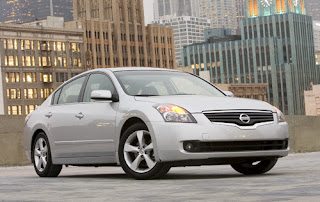
2nd Place: 2007 Nissan Altima 3.5 SE Sedan

Of all the sedans tested here, the Nissan Altima is the most sporting of the bunch. Not just because it blasts past the competition with a 67.3-mph pass through the slalom, but also because it feels just right through the controls. Thanks to the weight of the steering effort and character of the response, the action and feel of the brake pedal, and the suspension's firm control of body motion, the Altima speaks more clearly to enthusiasts than any other car here.At the same time, you don't have to be a car nut to appreciate the benefits of a communicative driving experience. The more attuned a driver is to a vehicle, the more confidence he will have behind the wheel. And as far as we're concerned, safety begins with confidence.Stiff tire sidewalls and firm damping contribute to the Nissan's precise character on the road, but they also produce a choppy ride, and this is the downside to the Altima's sporty bent. In addition, this is the only car in our test that recommends the use of premium fuel — the others drink regular, which can add up to real savings in the long run.Nissan's 270-hp 3.5-liter V6 has received accolades for years, and it remains a terrific all-around performer. The big surprise this time is that the Altima's continuously variable transmission (CVT) reaps the highest scores of any gearbox in our test.This CVT behaves as if it's been hard-wired into the mind of the driver, as its ability to know when to let 'er rip and when to dial things back is completely uncanny. The CVT also helps lend the Altima a far more eager disposition than the quicker-by-the-clock Malibu. And we love the CVT's refined yet super-quick manual-mode shift program.Broad, flat front seats are a glaring flaw in the Altima's driver-oriented mission, as they don't provide the support that's necessary. Backseat passengers fare better, though headroom is lacking. The surroundings in either situation are of high quality, if on the austere side.If you want features, the Altima is the car for you. Armed with a back-up camera, dual-zone HVAC, a keyless ignition system, DVD-based navigation, sunroof and Bluetooth, our Altima is the most comprehensively equipped sedan here.You pay for all this, though. At $32,545 as-tested, the Altima is the most expensive car of the bunch, a factor that takes a toll on the car's final placement in this comparison. And be aware that the Altima's options are clustered into expensive packages rather than being available à la carte.

3rd Place: 2008 Chevrolet Malibu LTZ


The 2008 Malibu has literally entered the big time. Riding on a longer wheelbase and weighing more than any of its rivals, the 2008 Malibu has stepped up both its size and its game. As if to underscore its arrival, the big Chevy's presence is graced with distinctively elegant styling.At the same time, there are practical compromises forced by the Malibu's style. The small greenhouse and thick C-pillars noticeably compromise outward visibility and impart a less spacious feel to the cabin. Meanwhile, the high-bustle tail has the highest trunk liftover height in our test. On the plus side, the Malibu's deck lid has scissor-type hinges that don't intrude on trunk space at all, unlike the gooseneck hinges on the other cars.Though our opinions about the interior color scheme of this Malibu LTZ were sharply divided, we all agree that the interior itself simultaneously impresses and frustrates. The Malibu's dashboard is impeccably fitted, yet the black plastic pieces look cheap. And if you're looking for dual-zone HVAC, Bluetooth compatibility, and keyless ignition, you won't find them in the Malibu, as this car's cost-conscious character means they can't even be found on the options list. However, OnStar is standard on the Malibu, a feature no other car in this comparison offers.Freeway cruises are a treat in the Malibu, as it's extremely quiet and quells wind noise better than any other car in our test. The front seats were universally lauded as the best in this bunch thanks to a first-rate combination of both comfort and support. By contrast, the rear seat offers the least amount of useful space and the fewest frills of all the cars here. Rear headroom is snug, the seat cushions are flat and there's no flip-down center armrest. (The Malibu is the only car here without one.)On the dynamic front, the Malibu's steering lacks feel, yet the effort loads up nicely in a corner and matches the well-controlled body motions. In fact, the Malibu sports the best compromise between ride and handling in our test, admirably dispensing with road harshness while still maintaining composure on winding bits of pavement. Moreover, the Malibu's brakes have plenty of stopping power, and this car turns in the shortest stopping distance from 60 mph.The Malibu ties the Camry in the sprint to 60 mph and posts the second-quickest quarter-mile time thanks to the solid traction available when it's launched hard. The Chevy's trap speed in the quarter-mile reflects a power deficit in this comparison, yet 252 hp and 251 pound-feet of torque from the 3.6-liter DOHC V6 ensure the Malibu never feels lacking for oomph when the throttle pedal meets the carpet.The Malibu's six-speed automatic transmission garners some black marks from us due to its lazy part-throttle calibration, which dulls the engine's potency. Top gear is summoned at every opportunity, and the gearbox doggedly refuses to downshift in a timely fashion. This is clearly a measure to enhance fuel economy, yet it also gives the car a sluggish disposition around town despite the V6's respectably broad power band.With a $27,245 as-tested price that undercuts its competition, the Malibu has a head start in our test scoring, but a relative lack of equipment and indifferent evaluation scores ultimately place it midpack. These shortcomings aside, the Malibu is a stylish, impressive car that commands attention and also deserves it.

4th Place: 2007 Toyota Camry XLE V6 Sedan

Kapow! The Camry, the clear winner of our last comparison test for V6 sedans, has been blown off by its newly refurbished rivals. Though it finishes in last place, the Camry remains well-equipped and powerful, but it's simply been leapfrogged by a new generation of competitors, largely because of driving dynamics.And we're not just referring to driving on the ragged edge like some hooligan either. Even in routine driving, the Camry's soft ride and deliberate chassis responses make it feel poorly controlled, as if it's wallowing down the road. Similarly, the Camry's steering is reasonably precise, yet it feels almost completely numb. The result is a limp driving character that seems even more pronounced in contrast to the far more engaging personalities of its rivals. The Malibu in particular demonstrates that body control and a compliant ride are not mutually exclusive.Then you floor the throttle and the Camry aims to erase these impressions, flinging itself to the quarter-mile mark in 14.9 seconds at 96.4 mph, quicker and faster than any other car in this test. Its 268-hp V6 and six-speed automatic combine to deliver a sweet powertrain, with plenty of power everywhere in the rev range and a willingness to flex its muscles even during routine driving. Several times we found ourselves remarking that the Camry's chassis is almost comically overshadowed by the refined performance of this V6.Front headroom is tight for anyone taller than 6 feet, but the Camry XLE's backseat accommodations are pretty luxurious. There is plenty of space, plus contoured seats that recline, a feature not found in any of the other sedans. Unfortunately, this design forces the deletion of the 60/40-split-folding function, and there's just a small pass-through into the trunk. Lesser trim levels of the Camry offer a split-folding seat, so you can decide whether your priority is passenger accommodation or available cargo volume.The build quality of our Camry test car trailed the others, and we noted more inconsistent interior panel gaps and interior squeaks and rattles than we'd expect from a car with fewer than 11,000 miles. The equipment level of this XLE model is fairly high, but it also results in the second highest as-tested price of $31,619, which proves to be yet another factor that weighs against it in the final analysis.Time has marched on, and what was outstanding a year ago is merely good today.

Here's a link to the article;

http://www.edmunds.com/insideline/do/Drives/Comparos/articleId=123842?tid=edmunds.il.home.photopanel..1.*#68

Tuesday, December 4, 2007

2nd Generation Honda Fit, 2009 for us North Americans

This is the 'refresh mode' or otherwise called 'inspiration point' mode.
This car is called a Honda Jazz in other parts of the world (Europe and Japan to name a couple). Even though us in North America have only had this car since the 2007 model year it has been out in the world since 2001, which put it due for a major makeover everywhere else. Here are some snap shots of what the rest of the world has access to and what we will be able to buy for the 2009 model year.
Changes from the 2008 are;
-Overall length, width and wheelbase have been increased.
-Tire Pressure Monitoring System is provided.
-An emergency tire repair kit is provided instead of a spare tire. (I am pretty sure we will see the spare tire here.)
-The front quarter windows are three times of the size of those in the previous model, and the width of the front pillar has been reduced by 20 mm to provide enhanced visibility.
-The rear seats are 20 mm wider, 15 mm deeper, and have cushions 10 mm thicker for enhanced ride comfort in comparison to previous model.
-The new Fit comes with either of two new engines: a 1.3 liter i-VTEC or a 1.5 liter i-VTEC.
Fit’s practicality has also been enhanced with four-mode “Ultra Seat” and three-mode “Ultra Luggage” storage spaces.
Here's a nice write up from Edmunds;