

We compare six family haulers and, amazingly, drown none of them.
BY JOHN PHILLIPS, PHOTOGRAPHY BY AARON KILEY November 2008
When we last visited Michigan’s Drummond Island [“Mud Puppies,” February 2008], we compared nine Lilliput SUVs and quickly found ourselves in over our heads. Which is to say, we sank a Jeep Liberty. See, the island—a short ferry ride from the eastern tip of the state’s Upper Peninsula—is a 25-mile-long series of limestone bowls (which hold water) and cedar swamps (ditto) surrounded by Lake Huron (ditto times a million). Drummond Island, thou art thine own soggy enemy.
This time, we asked Drummond Island Resort’s driving expert, Craig Hoffman, to sketch out a somewhat drier 16-mile loop, two-thirds of which comprised twisty, smooth pavement and one-third of which bumped through the resort’s private off-road facility. On any off-roader’s scale of difficulty, these private trails (notice we said “private” twice?) hover wholly in Wally Cox territory yet still represent pretty much the worst that any owner would throw at his investment. Along this route, we then ran the vehicles back-to-back until the local bowling alley’s neon “BEER” sign lit up.
Our goal was to compare six mid-size unibody crossovers with all-wheel drive, third-row seats, and the sort of interior volumes that would ensure family-hauling nirvana.
The Honda Pilot and the Toyota Highlander have recently been comprehensively refurbished, inside and out. Chevy’s Traverse is the latest flavor of the platform shared with Buick’s Enclave, GMC’s Acadia, and Saturn’s Outlook. The Traverse is the first we’ve tested with the direct-injection V-6, but the other three also get it for ’09. Hyundai’s Veracruz isn’t brand-new but has never competed in a C/D comparo. Having secured a position on our ’08 5Best Trucks list, Mazda’s CX-9 simply had to be in the mix. And although a Ford Taurus X might have looked a better fit in this group, we opted for the brand-new Flex. Both rely on the same drivetrain, and the Taurus X is soon to be discontinued.
Unibodies were the order of the day, so body-on-framers, such as Nissan’s Pathfinder, were excluded. Ditto a couple of crossovers with notably smaller interior volumes—Subaru’s Tribeca, for instance.
We had hoped that with AWD and a nice load of options our vehicles would all max out at about $38,000. Alas, the only Highlander that Toyota could offer, at least with a third-row seat, was a loaded $42,799 Limited, so we used it for back-seat tests only. The Highlander Sport we drove to the island had no third-row seat and was sparsely outfitted—cloth seats, for instance—but was a whale of a bargain at $33,648. Adding a third row to our car would bump its price to $34,433, which is the number we used in the chart and for scoring purposes.
We were disappointed that our six crossovers managed an observed average of only 19 mpg. Sign of the times: On the way north, we observed a man riding a Schwinn. With a bag of golf clubs slung over his shoulder and a full-size Igloo cooler in his left hand, he was a candidate for a closed head injury. “What you got there,” observed associate editor Tony Quiroga, “is a guy with an SUV parked in his garage.”
****1st Place****
2009 Honda Pilot EX-L 4WD

Highs: A veritable woodsman off-road, torsional rigidity of an I-beam.
Lows: Cluttered center stack, a firm ride, could use another 20 horses.
The Verdict: A civilized crossover that feels as unbreakable as a truck.
Lows: Cluttered center stack, a firm ride, could use another 20 horses.
The Verdict: A civilized crossover that feels as unbreakable as a truck.
Link to the full review;
****2nd Place****
2008 Mazda CX-9 Grand Touring AWD

Highs: Luxurious cabin, unhindered sightlines, great freeway cruiser.
Lows: Some high-frequency ride jitters, a sense of fragility off-road.
The Verdict: An SUV that replaces a minivan and comes out grinning.
Lows: Some high-frequency ride jitters, a sense of fragility off-road.
The Verdict: An SUV that replaces a minivan and comes out grinning.
Link to the full review;
****3rd Place****
2008 Toyota Highlander Sport 4X4

Highs: A rocket to 60 mph, ergonomic center stack, exquisite drivetrain.
Lows: Low-rent cabin surfaces, odd on-center steering feel, slim cargo capacity.
The Verdict: Soothingly carlike family fare that is affordably family fair.
Lows: Low-rent cabin surfaces, odd on-center steering feel, slim cargo capacity.
The Verdict: Soothingly carlike family fare that is affordably family fair.
Link to the full review;
****4th Place****
2009 Ford Flex SEL

Highs: World’s best middle-row seats, cool styling, easy ingress/egress.
Lows: Slow to react, a titch too much NVH, wheel too close to the IP.
The Verdict: As functional as pliers but needs to be more carlike to satisfy.
Lows: Slow to react, a titch too much NVH, wheel too close to the IP.
The Verdict: As functional as pliers but needs to be more carlike to satisfy.
Link to the full review;
****5th Place****
2009 Chevrolet Traverse LT

Highs: Solid structure, good roll control, a cabin as big as an auditorium.
Lows: Too heavy, poor visibility astern, some cheap cockpit surfaces.
The Verdict: Obesity affects every aspect of an SUV’s vehicular health.
Lows: Too heavy, poor visibility astern, some cheap cockpit surfaces.
The Verdict: Obesity affects every aspect of an SUV’s vehicular health.
Link to the full Review;
****6th Place****
2008 Hyundai Veracruz Limited AWD

Highs: Amenities galore, refined drivetrain, rides like a ’70s-era Caddy.
Lows: Way too much body roll, vague steering, platform feels twistable.
The Verdict: Functional, rational, justifiable—but not much fun to drive.
Lows: Way too much body roll, vague steering, platform feels twistable.
The Verdict: Functional, rational, justifiable—but not much fun to drive.
Link to the full review;
Here is the Test Sheet

 The Buzzard-and-Baloney Brigade - Comparison Test
 1st Place: 2008 Honda Accord EX Sedan
 In its 32-year existence, the Accord has landed on C/D’s 10Best Cars list
 Here's a nice comparison between to rival cars by Josh Jacquot, Senior Road Test Editor at Edmund's Online. I know it is a couple of years old, but the two cars are virtually the same today, so I didn't think it would matter.


 It's nice to see a 4 cylinder comparison between these cars, b/c I find most reviews are on the V6, but most people end up with the 4 cylinder. The 4 cylinder engine in the Accord from what I have found drives more like a small V6 anyway. (I used to drive a 1995 Pontiac Grand Am GT 3.1 litre V6 and I think the 4 cylinder in the Accord would put the 3.1 litre to bed.) I imagine the 4 cylinder in the new Malibu would be pretty energetic too (haven't driven one yet), and I know the Camry has a nice 4 cylinder as well. Anyway, onward to the write up highlights;
  A front-wheel-drive midsize sedan with a four-cylinder engine is an inherently sensible form of transportation. But the Toyota Camry LE takes it to an extreme, asking its driver to forgo all involvement in the motoring experience in trade for a soft, isolated ride, carefully insulated from the travails of everyday life. Similarly, the car's gray-on-gray interior is spacious, ergonomically sound and loaded with storage slots, but nonessential styling touches are kept to a minimum. It led to sensory deprivation, we discovered, and it further detracted from a car that had some deficits in feature content and had been built with inconsistent levels of fit and finish.
  As extroverted as the Camry is demure, the 2008 Chevrolet Malibu flashes a proud bowtie smile each time you walk up to it. There's good reason to smile back.
 Alongside the Malibu's staggering climb to legitimacy, the eighth-generation Honda Accord has quietly become the best family sedan ever.
 The 2008 Accord isn't the cheapest, fastest or most feature-laden car in our comparison. But if you're familiar with the Goldilocks effect, you already know how the Accord came to finish in 1st place.The Accord is a full 2.4 inches wider than the Malibu and devotes all of this to interior space, and the result is a notable impression of spaciousness combined with excellent visibility. Rear seat passengers are likewise treated very well, with ample thigh support and space easily sufficient for 6-footers during long road trips. There are also more useful storage bins and little nooks than in the other cars in this comparison.The quality of the materials is best in class. And since there are few of the usual chrome-plated bits masquerading as style items, the number of distracting reflections is kept to an absolute minimum. One area of the interior that could use some more work is the busy collection of buttons on the Accord's center stack. They're large and clearly labeled, but there are just too many of them lined up like bathroom tiles. On the other hand, the interface for the Accord EX-L's navigation system is the most intuitive to use by far, and there's thankfully no touchscreen to accumulate smeared fingerprints.Though it has a large cabin, the Accord doesn't drive like a large car. Its steering manages to be quick and communicative right around center, and this helps make the driving experience feel natural and intuitive. As it goes down the road, the Accord responds to surface imperfections with crisp suspension action that has just enough compliance to minimize complaints from the passengers, yet keep the driver in touch with reality. At the same time, we'll acknowledge that the Accord does feel a little too busy over some pocks and bumps, so the Honda engineers still have something to fuss over.Acceleration from the Accord's mannerly 3.5-liter SOHC V6 trails the pack on paper, since midrange grunt is not this engine's strong suit. Nevertheless, the Accord manages to squirt through the urban jungle with respectable speed thanks in large part to its cooperative five-speed transmission. Though the competition has adopted six-speed transmissions, Honda's five-speed manages to overcome its disadvantage with smart calibration and quick shift action. You won't miss the extra gear while climbing hills, since the transmission's excellent grade logic makes for frustration-free ascents.This V6 also incorporates cylinder deactivation, a system that promises to improve fuel economy, and it's easier to feel the transition between the system's modes than we'd hoped. Nevertheless, the Accord's EPA fuel economy estimates of 19 city/29 highway are the best in this group (once the 2007 models are adjusted to the 2008 EPA standards), and we're curious to see if the expected gains will materialize during our extended test of this long-term car. So far we've seen an average of 22.8 mpg over 2,200 miles, just slightly better than the 21.2 mpg over 18,575 miles recorded by our long-term Altima.Chart-topping evaluation scores and strong feature content at the second-lowest price in our test give the Accord the edge. And this reflects the wave of progress in this class of family sedans. Though these cars are not Camry-like in detail, they share the Camry's overall spirit of well-equipped quality, a measure of luxury in the family sedan world. The Chevrolet Malibu, Honda Accord, Nissan Altima and Toyota Camry have now left behind any overtones of down-size cheapness and embraced a new spirit of full-size sophistication.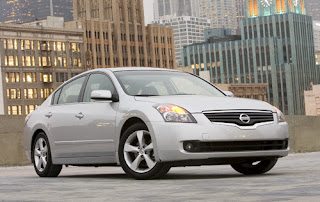

 Kapow! The Camry, the clear winner of our last comparison test for V6 sedans, has been blown off by its newly refurbished rivals. Though it finishes in last place, the Camry remains well-equipped and powerful, but it's simply been leapfrogged by a new generation of competitors, largely because of driving dynamics.And we're not just referring to driving on the ragged edge like some hooligan either. Even in routine driving, the Camry's soft ride and deliberate chassis responses make it feel poorly controlled, as if it's wallowing down the road. Similarly, the Camry's steering is reasonably precise, yet it feels almost completely numb. The result is a limp driving character that seems even more pronounced in contrast to the far more engaging personalities of its rivals. The Malibu in particular demonstrates that body control and a compliant ride are not mutually exclusive.Then you floor the throttle and the Camry aims to erase these impressions, flinging itself to the quarter-mile mark in 14.9 seconds at 96.4 mph, quicker and faster than any other car in this test. Its 268-hp V6 and six-speed automatic combine to deliver a sweet powertrain, with plenty of power everywhere in the rev range and a willingness to flex its muscles even during routine driving. Several times we found ourselves remarking that the Camry's chassis is almost comically overshadowed by the refined performance of this V6.Front headroom is tight for anyone taller than 6 feet, but the Camry XLE's backseat accommodations are pretty luxurious. There is plenty of space, plus contoured seats that recline, a feature not found in any of the other sedans. Unfortunately, this design forces the deletion of the 60/40-split-folding function, and there's just a small pass-through into the trunk. Lesser trim levels of the Camry offer a split-folding seat, so you can decide whether your priority is passenger accommodation or available cargo volume.The build quality of our Camry test car trailed the others, and we noted more inconsistent interior panel gaps and interior squeaks and rattles than we'd expect from a car with fewer than 11,000 miles. The equipment level of this XLE model is fairly high, but it also results in the second highest as-tested price of $31,619, which proves to be yet another factor that weighs against it in the final analysis.Time has marched on, and what was outstanding a year ago is merely good today.

