
Edmunds Engineering Editor Jason Kavanagh did a nice write up comparing the 2008 Honda Accord EX-L V6 Sedan, 2007 Nissan Altima 3.5 SE Sedan, 2008 Chevrolet Malibu LTZ V6 Sedan, and the 2007 Toyota Camry XLE V6 sedan.
Each of the four entrants chosen for their comparison test represents the highest available trim level, and each is also packed with nearly every available option and an overachieving V6 power plant driving the front wheels. Heck, the least powerful engine in this test churns out 252 horsepower, a figure that was unheard of in the mainstream sedan world not long ago.
Here's the results;
1st Place: 2008 Honda Accord EX-L V6 Sedan
The 2008 Accord isn't the cheapest, fastest or most feature-laden car in our comparison. But if you're familiar with the Goldilocks effect, you already know how the Accord came to finish in 1st place.The Accord is a full 2.4 inches wider than the Malibu and devotes all of this to interior space, and the result is a notable impression of spaciousness combined with excellent visibility. Rear seat passengers are likewise treated very well, with ample thigh support and space easily sufficient for 6-footers during long road trips. There are also more useful storage bins and little nooks than in the other cars in this comparison.The quality of the materials is best in class. And since there are few of the usual chrome-plated bits masquerading as style items, the number of distracting reflections is kept to an absolute minimum. One area of the interior that could use some more work is the busy collection of buttons on the Accord's center stack. They're large and clearly labeled, but there are just too many of them lined up like bathroom tiles. On the other hand, the interface for the Accord EX-L's navigation system is the most intuitive to use by far, and there's thankfully no touchscreen to accumulate smeared fingerprints.Though it has a large cabin, the Accord doesn't drive like a large car. Its steering manages to be quick and communicative right around center, and this helps make the driving experience feel natural and intuitive. As it goes down the road, the Accord responds to surface imperfections with crisp suspension action that has just enough compliance to minimize complaints from the passengers, yet keep the driver in touch with reality. At the same time, we'll acknowledge that the Accord does feel a little too busy over some pocks and bumps, so the Honda engineers still have something to fuss over.Acceleration from the Accord's mannerly 3.5-liter SOHC V6 trails the pack on paper, since midrange grunt is not this engine's strong suit. Nevertheless, the Accord manages to squirt through the urban jungle with respectable speed thanks in large part to its cooperative five-speed transmission. Though the competition has adopted six-speed transmissions, Honda's five-speed manages to overcome its disadvantage with smart calibration and quick shift action. You won't miss the extra gear while climbing hills, since the transmission's excellent grade logic makes for frustration-free ascents.This V6 also incorporates cylinder deactivation, a system that promises to improve fuel economy, and it's easier to feel the transition between the system's modes than we'd hoped. Nevertheless, the Accord's EPA fuel economy estimates of 19 city/29 highway are the best in this group (once the 2007 models are adjusted to the 2008 EPA standards), and we're curious to see if the expected gains will materialize during our extended test of this long-term car. So far we've seen an average of 22.8 mpg over 2,200 miles, just slightly better than the 21.2 mpg over 18,575 miles recorded by our long-term Altima.Chart-topping evaluation scores and strong feature content at the second-lowest price in our test give the Accord the edge. And this reflects the wave of progress in this class of family sedans. Though these cars are not Camry-like in detail, they share the Camry's overall spirit of well-equipped quality, a measure of luxury in the family sedan world. The Chevrolet Malibu, Honda Accord, Nissan Altima and Toyota Camry have now left behind any overtones of down-size cheapness and embraced a new spirit of full-size sophistication.
2nd Place: 2007 Nissan Altima 3.5 SE Sedan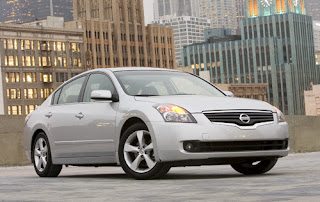 Of all the sedans tested here, the Nissan Altima is the most sporting of the bunch. Not just because it blasts past the competition with a 67.3-mph pass through the slalom, but also because it feels just right through the controls. Thanks to the weight of the steering effort and character of the response, the action and feel of the brake pedal, and the suspension's firm control of body motion, the Altima speaks more clearly to enthusiasts than any other car here.At the same time, you don't have to be a car nut to appreciate the benefits of a communicative driving experience. The more attuned a driver is to a vehicle, the more confidence he will have behind the wheel. And as far as we're concerned, safety begins with confidence.Stiff tire sidewalls and firm damping contribute to the Nissan's precise character on the road, but they also produce a choppy ride, and this is the downside to the Altima's sporty bent. In addition, this is the only car in our test that recommends the use of premium fuel — the others drink regular, which can add up to real savings in the long run.Nissan's 270-hp 3.5-liter V6 has received accolades for years, and it remains a terrific all-around performer. The big surprise this time is that the Altima's continuously variable transmission (CVT) reaps the highest scores of any gearbox in our test.This CVT behaves as if it's been hard-wired into the mind of the driver, as its ability to know when to let 'er rip and when to dial things back is completely uncanny. The CVT also helps lend the Altima a far more eager disposition than the quicker-by-the-clock Malibu. And we love the CVT's refined yet super-quick manual-mode shift program.Broad, flat front seats are a glaring flaw in the Altima's driver-oriented mission, as they don't provide the support that's necessary. Backseat passengers fare better, though headroom is lacking. The surroundings in either situation are of high quality, if on the austere side.If you want features, the Altima is the car for you. Armed with a back-up camera, dual-zone HVAC, a keyless ignition system, DVD-based navigation, sunroof and Bluetooth, our Altima is the most comprehensively equipped sedan here.You pay for all this, though. At $32,545 as-tested, the Altima is the most expensive car of the bunch, a factor that takes a toll on the car's final placement in this comparison. And be aware that the Altima's options are clustered into expensive packages rather than being available à la carte.
3rd Place: 2008 Chevrolet Malibu LTZ
 The 2008 Malibu has literally entered the big time. Riding on a longer wheelbase and weighing more than any of its rivals, the 2008 Malibu has stepped up both its size and its game. As if to underscore its arrival, the big Chevy's presence is graced with distinctively elegant styling.At the same time, there are practical compromises forced by the Malibu's style. The small greenhouse and thick C-pillars noticeably compromise outward visibility and impart a less spacious feel to the cabin. Meanwhile, the high-bustle tail has the highest trunk liftover height in our test. On the plus side, the Malibu's deck lid has scissor-type hinges that don't intrude on trunk space at all, unlike the gooseneck hinges on the other cars.Though our opinions about the interior color scheme of this Malibu LTZ were sharply divided, we all agree that the interior itself simultaneously impresses and frustrates. The Malibu's dashboard is impeccably fitted, yet the black plastic pieces look cheap. And if you're looking for dual-zone HVAC, Bluetooth compatibility, and keyless ignition, you won't find them in the Malibu, as this car's cost-conscious character means they can't even be found on the options list. However, OnStar is standard on the Malibu, a feature no other car in this comparison offers.Freeway cruises are a treat in the Malibu, as it's extremely quiet and quells wind noise better than any other car in our test. The front seats were universally lauded as the best in this bunch thanks to a first-rate combination of both comfort and support. By contrast, the rear seat offers the least amount of useful space and the fewest frills of all the cars here. Rear headroom is snug, the seat cushions are flat and there's no flip-down center armrest. (The Malibu is the only car here without one.)On the dynamic front, the Malibu's steering lacks feel, yet the effort loads up nicely in a corner and matches the well-controlled body motions. In fact, the Malibu sports the best compromise between ride and handling in our test, admirably dispensing with road harshness while still maintaining composure on winding bits of pavement. Moreover, the Malibu's brakes have plenty of stopping power, and this car turns in the shortest stopping distance from 60 mph.The Malibu ties the Camry in the sprint to 60 mph and posts the second-quickest quarter-mile time thanks to the solid traction available when it's launched hard. The Chevy's trap speed in the quarter-mile reflects a power deficit in this comparison, yet 252 hp and 251 pound-feet of torque from the 3.6-liter DOHC V6 ensure the Malibu never feels lacking for oomph when the throttle pedal meets the carpet.The Malibu's six-speed automatic transmission garners some black marks from us due to its lazy part-throttle calibration, which dulls the engine's potency. Top gear is summoned at every opportunity, and the gearbox doggedly refuses to downshift in a timely fashion. This is clearly a measure to enhance fuel economy, yet it also gives the car a sluggish disposition around town despite the V6's respectably broad power band.With a $27,245 as-tested price that undercuts its competition, the Malibu has a head start in our test scoring, but a relative lack of equipment and indifferent evaluation scores ultimately place it midpack. These shortcomings aside, the Malibu is a stylish, impressive car that commands attention and also deserves it.
4th Place: 2007 Toyota Camry XLE V6 Sedan
 Kapow! The Camry, the clear winner of our last comparison test for V6 sedans, has been blown off by its newly refurbished rivals. Though it finishes in last place, the Camry remains well-equipped and powerful, but it's simply been leapfrogged by a new generation of competitors, largely because of driving dynamics.And we're not just referring to driving on the ragged edge like some hooligan either. Even in routine driving, the Camry's soft ride and deliberate chassis responses make it feel poorly controlled, as if it's wallowing down the road. Similarly, the Camry's steering is reasonably precise, yet it feels almost completely numb. The result is a limp driving character that seems even more pronounced in contrast to the far more engaging personalities of its rivals. The Malibu in particular demonstrates that body control and a compliant ride are not mutually exclusive.Then you floor the throttle and the Camry aims to erase these impressions, flinging itself to the quarter-mile mark in 14.9 seconds at 96.4 mph, quicker and faster than any other car in this test. Its 268-hp V6 and six-speed automatic combine to deliver a sweet powertrain, with plenty of power everywhere in the rev range and a willingness to flex its muscles even during routine driving. Several times we found ourselves remarking that the Camry's chassis is almost comically overshadowed by the refined performance of this V6.Front headroom is tight for anyone taller than 6 feet, but the Camry XLE's backseat accommodations are pretty luxurious. There is plenty of space, plus contoured seats that recline, a feature not found in any of the other sedans. Unfortunately, this design forces the deletion of the 60/40-split-folding function, and there's just a small pass-through into the trunk. Lesser trim levels of the Camry offer a split-folding seat, so you can decide whether your priority is passenger accommodation or available cargo volume.The build quality of our Camry test car trailed the others, and we noted more inconsistent interior panel gaps and interior squeaks and rattles than we'd expect from a car with fewer than 11,000 miles. The equipment level of this XLE model is fairly high, but it also results in the second highest as-tested price of $31,619, which proves to be yet another factor that weighs against it in the final analysis.Time has marched on, and what was outstanding a year ago is merely good today.
Here's a link to the article;
http://www.edmunds.com/insideline/do/Drives/Comparos/articleId=123842?tid=edmunds.il.home.photopanel..1.*#68
 Comparison Test: 2009 Mazda 6 vs. 2008 Honda Accord vs. 2008 Nissan Altima
 1st Place: 2009 Mazda 6 - For 2009 Mazda takes the styling up a notch, dials out some harshness and dethrones the benchmark Honda Accord.
 2nd Place: 2008 Honda Accord - Providing exactly what's expected but nothing more, the Accord will still supply miles of performance.
 3rd Place: 2008 Nissan Altima - Widely considered the sportiest front-drive family sedan, the slick Altima comes up short this time around.


 Excerpt from Press Release dated 8/7/2008


